 العربية
 English
 Türkçe
 Français
Guide to Solar Panel Types: Mono, Poly, Bifacial - Which Is Best for Your Home?
Welcome! When you decide to install a solar energy system for your home, the first and most important decision you'll face is choosing the type of panels to put on your roof. Many people get confused between terms like "Mono" and "Poly," and recently there's been a lot of talk about Bifacial panels. In this simplified engineering guide, we'll break it all down in plain language so you know exactly which panel meets your needs, fits your budget and roof space, without getting lost in market hype.
1. Theoretical Section: Silicon Cell Technology and Understanding the Differences
All commercially available solar panels rely on silicon as a semiconductor material to absorb light and generate electricity, but the fundamental difference lies in how the silicon alloys are manufactured and their crystalline structure.
1.1 Monocrystalline Panels
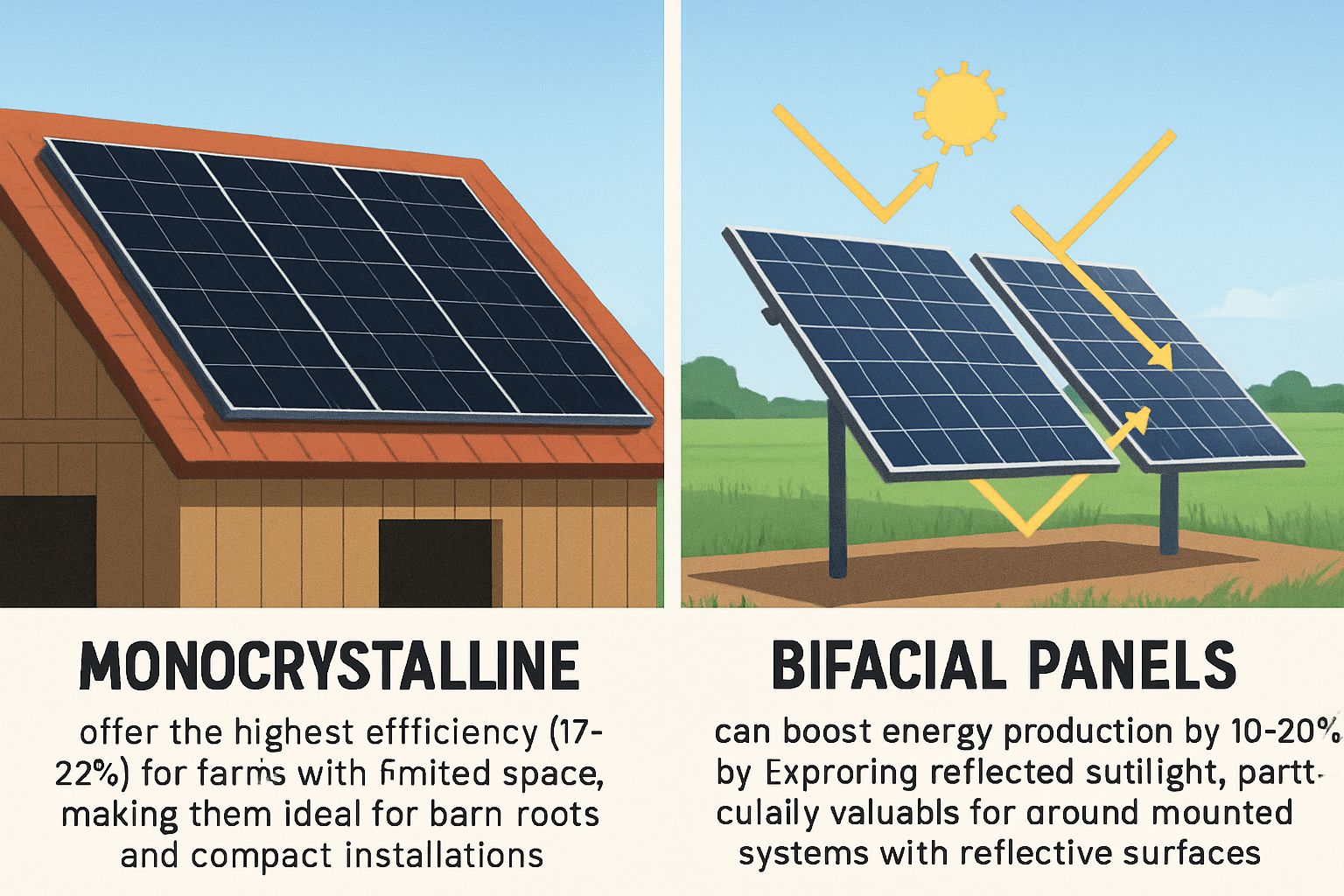
Monocrystalline panels, or Mono, are manufactured from a single, high-purity silicon crystal. That's why they appear in a uniform dark black color, with cells that have clipped, rounded corners. The high purity of the silicon here gives electrons greater freedom of movement, which significantly raises efficiency compared to other types. Additionally, Monocrystalline panels offer excellent performance in low-light conditions and hot climates.
1.2 Polycrystalline Panels
Polycrystalline panels, or Poly, are manufactured by melting silicon fragments together and pouring them into square molds. This process gives the cells a mottled blue appearance with visible crystal reflections. Since the crystalline structure here is not uniform, electron movement is slightly harder, which means lower efficiency than Mono and more space required to generate the same power output. On the flip side, manufacturing costs are lower, and this is reflected in their market price.
1.3 Bifacial Panels and the Albedo Concept
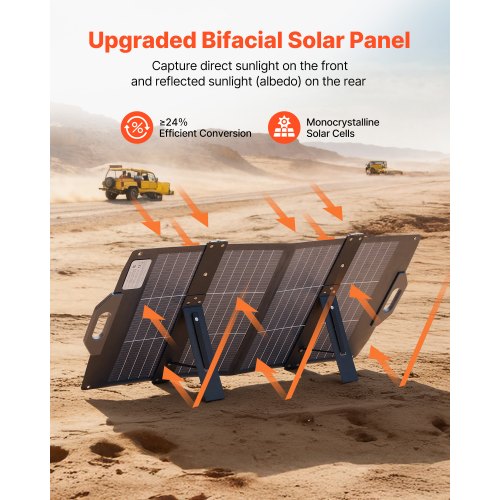
This is an incredible development in the solar energy world! Bifacial panels are designed to generate electricity from both the front face (directly facing the sun) and the rear face. The rear face absorbs light reflected off the ground or nearby surfaces. This is where a very important engineering term comes in: Albedo (reflectance coefficient) — the lighter and more reflective the ground surface beneath the panel (such as white gravel or white-painted surfaces), the more the rear face produces, with gains that can reach an additional 10% to 25%.
2. Practical Section: Calculating Efficiency and Reading the Datasheet
When you pick up the datasheet for any solar panel, you need to focus on international quality standards and calculation formulas that determine actual performance under real weather conditions in our region.
2.1 International Panel Efficiency Standards (IEC 61215)
Before buying any panel, make sure it has an IEC 61215 certification printed on the panel or in the datasheet. This international standard issued by the International Electrotechnical Commission ensures the panel has undergone rigorous testing that proves its mechanical and electrical durability, and its ability to withstand weather factors such as high humidity, heat, and strong winds.
When using Bifacial panels, the expected current intensity calculations in the engineering design must be adjusted according to IEC 62548, because the actual current flowing through cables and charge controllers may exceed the short-circuit current listed for the front face by up to 20% due to rear-side reflection. Failing to account for this poses a serious risk of burning connections and wiring.
2.2 Calculating the Effect of Temperature on Actual Output
A lot of people think that higher temperatures mean more panel output, and this is a dangerously wrong assumption! Panels operate at peak efficiency when cell temperature is 25°C (known as Standard Test Conditions, STC). Above this temperature, efficiency starts to drop based on a factor called the Temperature Coefficient of Power ($\gamma$), which is listed as a negative value on the datasheet (e.g., -0.35%/°C).
To calculate the actual power output of a panel when temperatures rise during summer, we apply the following engineering formula:
$$P_{\text{actual}}=P_{\text{STC}}\times\left[1+\left(\frac{\gamma}{100}\times(T_{\text{cell}}-25)\right)\right]$$Where:
- $P_{\text{actual}}$: Actual power output under summer heat (watts).
- $P_{\text{STC}}$: The panel's nominal rated power (e.g., 550 watts).
- $\gamma$: Temperature coefficient (e.g., -0.35%/°C).
- $T_{\text{cell}}$: Actual cell temperature (which is typically 20 to 30°C higher than ambient temperature under direct sunlight).
2.3 The Importance of NOCT in Calculations
Another important factor on the datasheet is NOCT (Nominal Operating Cell Temperature), which determines the actual cell temperature under real operating conditions (typically 45-48°C). This factor helps you calculate actual performance more accurately.
3. Comprehensive Comparison Table of the Three Types
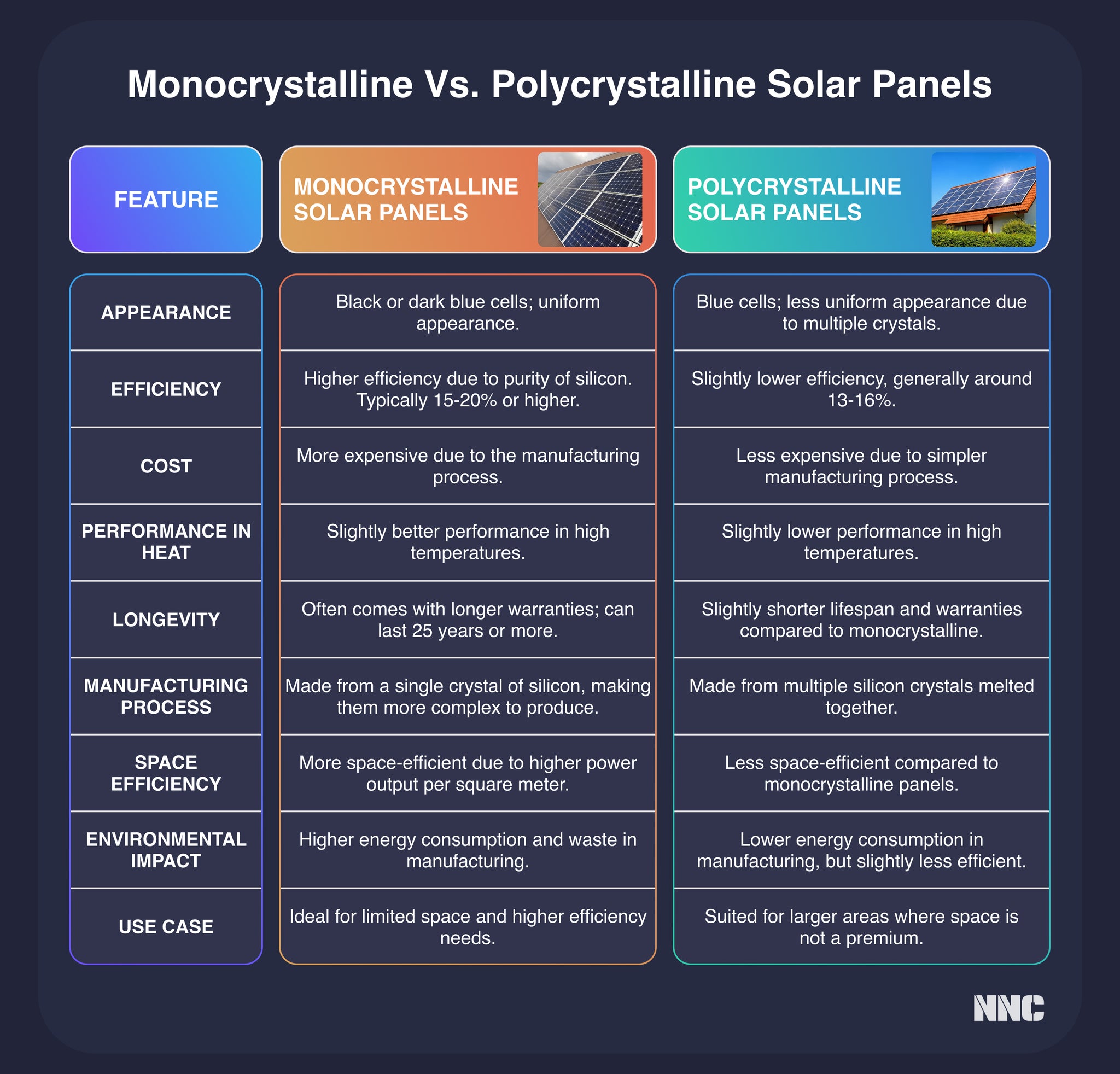
| Criterion | Monocrystalline (Mono) | Polycrystalline (Poly) | Bifacial |
|---|---|---|---|
| Average Commercial Efficiency | 19% - 22% | 15% - 17% | 21% - 23% (and may increase thanks to the rear face) |
| Installation Space Required | Small (efficiently utilizes roof space) | Large (requires more space for the same power) | Small (and delivers higher output in the same space) |
| Economic Cost | Medium to high | Low and economical | High (and requires special installation conditions) |
| Best Operating Environment | Typical residential roofs with limited space | Large-scale agricultural projects with open spaces | Warehouses, white-painted roofs, or light-colored sandy surfaces |
4. How to Choose the Right Type for Your Roof
To make the right decision without getting lost, follow these simple rules from real-world experience:
- If your roof space is tight and limited: Your first and only choice is Monocrystalline panels (Mono), because they give you the highest possible power per square meter. To understand how these panels affect your overall system calculations, we recommend checking out the Comprehensive Guide to Calculating a Residential Solar System to connect panel capacity with battery sizing.
- If you have plenty of ground space and a tight budget: Polycrystalline panels (Poly) can work for you and save on upfront costs, as long as you don't mind the space consumed.
- If your roof is elevated from the ground and painted in a reflective white color: This is where Bifacial panels will shine and deliver excellent output gains that justify their higher price. Always remember that panel orientation plays a crucial role in output, and you can check out our dedicated article on Tilt Angle and Correct Orientation for Solar Panels to ensure maximum efficiency from both faces.
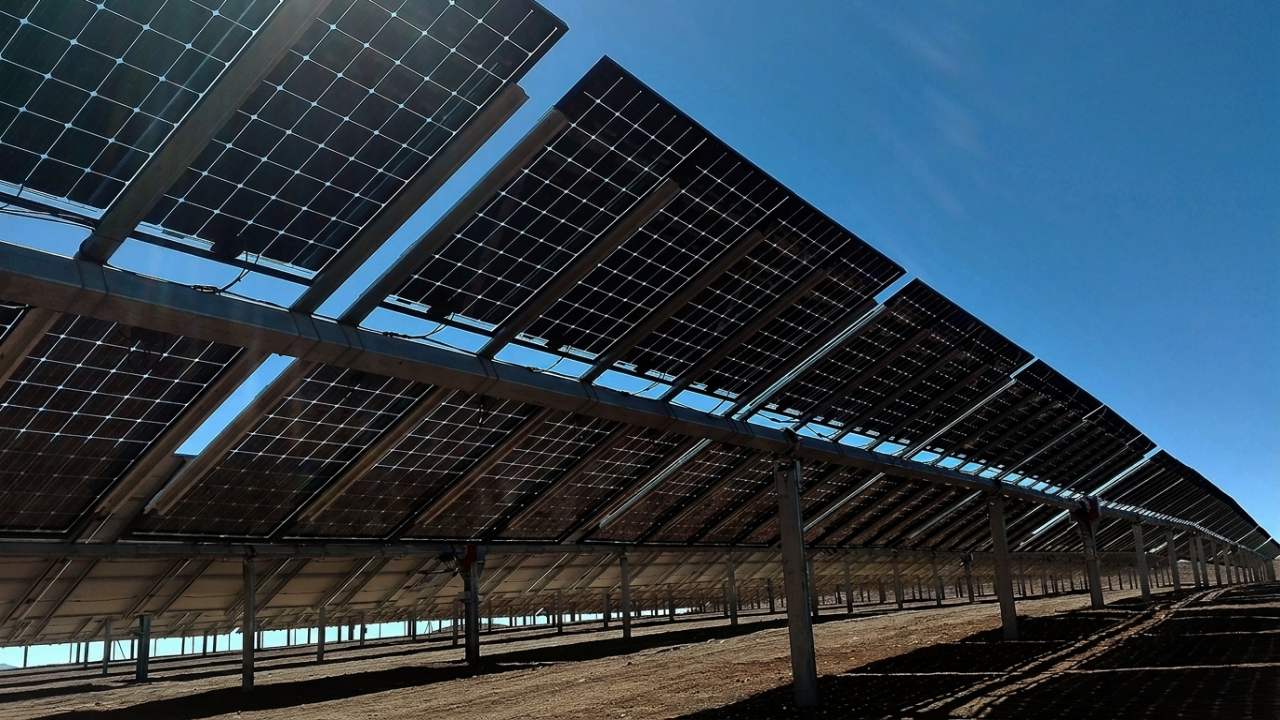
Figure 4: Practical example of Bifacial panel installation on a reflective white surface with optimal elevation
💡 Try the Solar Systems Designer Calculator Now!
Now that you know the panel specs, head over to our precise engineering calculator and find out how many panels your home needs and your full system size with a single click — completely free.
Go to Calculator ⚡Conclusion
At the end of the day, there's no such thing as an absolutely "bad" or "excellent" panel — there's only the panel that's best suited to your project's nature and budget. Mono panels are the queen of residential roofs today, Bifacial panels are the future choice for reflection-ready locations, while Poly panels still hold their place in large-scale economical projects. Always make sure your panels meet international IEC specifications to guarantee a safe and sustainable investment for the next 25 years.
The Bloomberg NEF Tier 1 classification ensures the manufacturer is reliable and financially strong, which guarantees you a genuine 25-year warranty and available spare parts.
Frequently Asked Questions About Solar Panel Types
Are Black Panels (Mono) Always Better Than Blue Ones (Poly)?
In terms of efficiency, heat performance, and space — yes, they are better. But economically, if you have plenty of available space, blue panels save you money on the initial investment.
Do Bifacial Panels Work on a Regular House with a Standard Concrete Roof?
They do work, but if the concrete roof is dark and there isn't enough clearance (height) between the panel and the ground, you won't truly benefit from the rear face advantage. It's recommended to paint the roof white or elevate the panels to at least 1 meter for full benefit.
How Do I Know If a Solar Panel Is Genuine and the Dealer Didn't Scam Me?
The solution is to rely on Tier 1 global brands, verify the presence of IEC 61215 certification, and match the serial number (barcode) found under the panel glass with the included test certificate.